THE INTERSTELLAR RECORD
VOYAGER 1 MISSION STATUS: ACTIVE
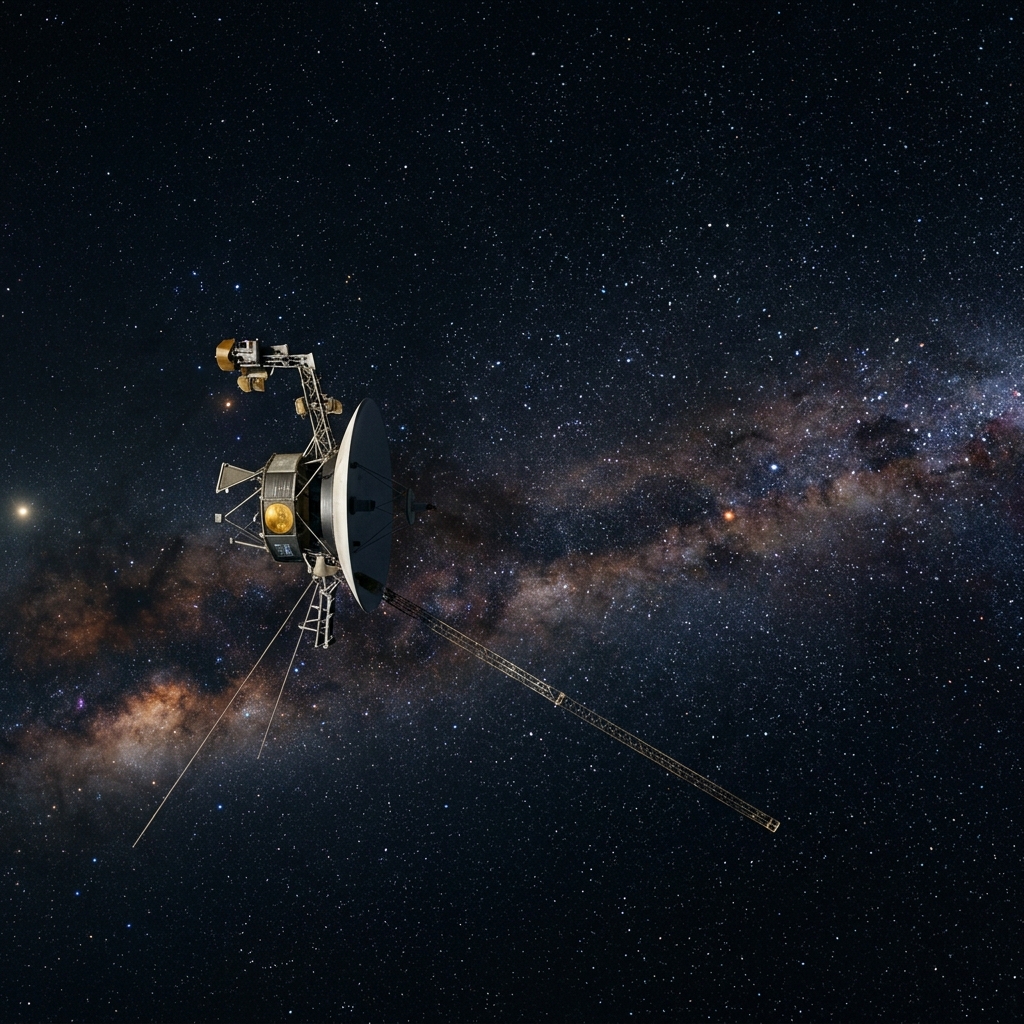
The Longest Transmission
Voyager 1 is the most distant human-made object in existence. Launched in 1977, it has surpassed every expectation, surviving the intense radiation of Jupiter, the rings of Saturn, and finally, the boundary of our solar system itself. It is now a lonely sentinel drifting through the cold, dark expanse between stars.
I. INTERSTELLAR DEPARTURE
On August 25, 2012, Voyager 1 became the first spacecraft to cross the heliopause—the point where the solar wind is stopped by the interstellar medium. This milestone marked humanity's transition into the galaxy at large. Today, the probe continues to return data on the density of plasma and the strength of magnetic fields in this unexplored territory.
II. THE GOLDEN RECORD
Fixed to the side of the craft is a gold-plated copper phonograph record containing sounds and images selected to portray the diversity of life and culture on Earth. It is a time capsule, intended to communicate our story to any extraterrestrial civilization that might inhabit distant star systems millions of years in our future.
III. FINAL POWER MANAGEMENT
The craft's radioisotope thermoelectric generators (RTGs) are slowly losing power. NASA mission controllers have begun shutting down non-essential instruments to prioritize the most critical interstellar sensors. Current estimates suggest Voyager 1 will remain capable of transmitting data until approximately 2027, after which it will continue its silent journey through the cosmos.