JOVIAN OCEAN EXPLORER
EUROPA CLIPPER STATUS: CRUISE PHASE
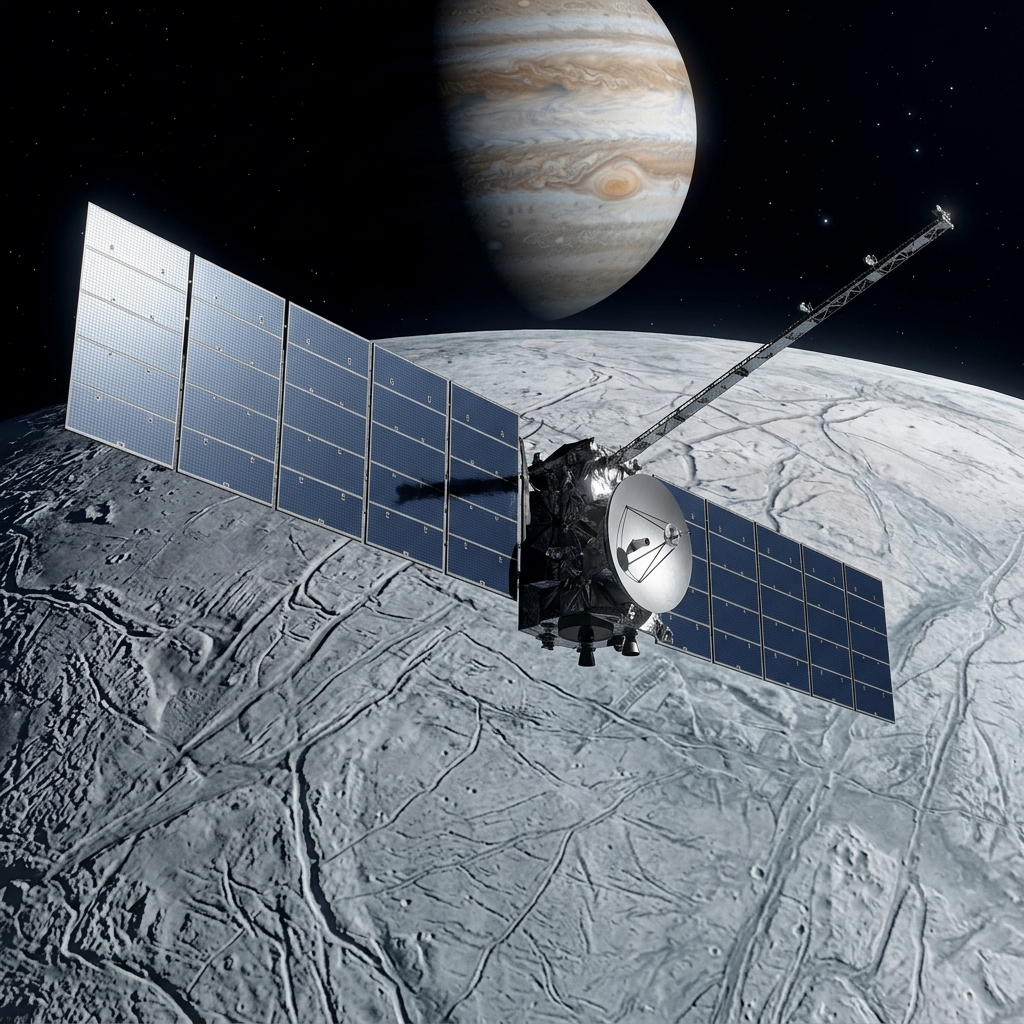
Clipper: The Ice Breaker
Europa Clipper is NASA's most advanced planetary mission to date. Its goal is to determine if the icy moon Europa, which orbits Jupiter, could harbor conditions suitable for life. Beneath its frozen shell, Europa is believed to hold a massive liquid water ocean that may be in contact with its rocky mantle—a key requirement for biological activity.
I. THE FLYBY STRATEGY
Instead of orbiting Europa directly—where the intense radiation from Jupiter's magnetic field would quickly destroy electronics—Clipper will orbit Jupiter and perform 49 flybys of Europa. This strategy allows the spacecraft to dive into the danger zone, gather data from a few hundred miles above the surface, and then retreat to safety to transmit that data back to Earth.
II. ICE-PENETRATING RADAR
One of Clipper's most critical instruments is the REASON radar system. It will pulse radio waves through Europa's ice shell (estimated to be 10-15 miles thick) to map the subsurface structure. This will reveal the depth of the ocean, the thickness of the ice, and whether there are "pockets" of liquid water closer to the surface that could erupt as plumes.
III. CHEMICAL SIGNATURES
The spacecraft also carries mass spectrometers and dust analyzers to "taste" the atmosphere. If Europa is venting plumes of water vapor and organic molecules into space, Clipper will fly right through them, sampling the chemistry of the hidden ocean without ever needing to land.