HOME FROM THE MOON
ARTEMIS II MISSION COMPLETE
Artemis II: Home from the Moon
Artemis II is now complete, and it delivered exactly what NASA and its partners needed from the first crewed test flight of the Artemis era: a safe deep-space mission, a successful lunar flyby, and a clean return to Earth. Orion splashed down in the Pacific at 8:07 p.m. EDT / 5:07 p.m. PDT on April 10, 2026, after a mission of nearly 10 days, returning commander Reid Wiseman, pilot Victor Glover, mission specialist Christina Koch, and Canadian Space Agency mission specialist Jeremy Hansen from humanity’s first crewed trip around the Moon in more than 50 years.
I. PROVING THE SYSTEM
The mission began on April 1, 2026, when NASA’s Space Launch System lifted Orion from Launch Complex 39B at Kennedy Space Center with 8.8 million pounds of thrust. Early in the flight, the crew completed one of the mission’s most important demonstrations: manually flying Orion in proximity to the spent interim cryogenic propulsion stage, validating close-range spacecraft handling, onboard navigation sensors, and reaction-control performance with crew aboard. That mattered because Artemis II was never only about reaching the Moon — it was about proving the full crewed system, from launch through flight operations, re-entry, recovery, and post-flight data return.
II. DEEP SPACE OPERATIONS
As Orion headed outbound, the crew checked life-support, communications, navigation, and emergency procedures in true deep-space conditions, including operations beyond the range of GPS and NASA’s near-Earth relay infrastructure. On the way to the Moon, the astronauts also worked as both operators and research subjects, supporting a suite of human-health investigations focused on sleep, stress, cognition, immune response, radiation exposure, and how the body adapts outside low Earth orbit. Among the named studies were ARCHeR, Immune Biomarkers, AVATAR, Standard Measures, and radiation monitoring inside the crew module.
III. THE LUNAR ENCOUNTER
The lunar flyby was the emotional and scientific centerpiece of the mission. Orion passed within 4,067 miles of the Moon at closest approach, and the crew spent hours observing and photographing the lunar surface, including far-side terrain and geological features that had never been seen directly by humans with the naked eye in this way. NASA said the mission set a new record for the farthest human spaceflight, reaching 252,756 miles from Earth at maximum distance and traveling 694,481 miles total over the course of the mission. Imagery released during and after the flyby included high-resolution views of the Moon and a rare in-space solar eclipse, turning Artemis II into both a systems test and a genuine scientific observation mission.
IV. RETURN & RECOVERY
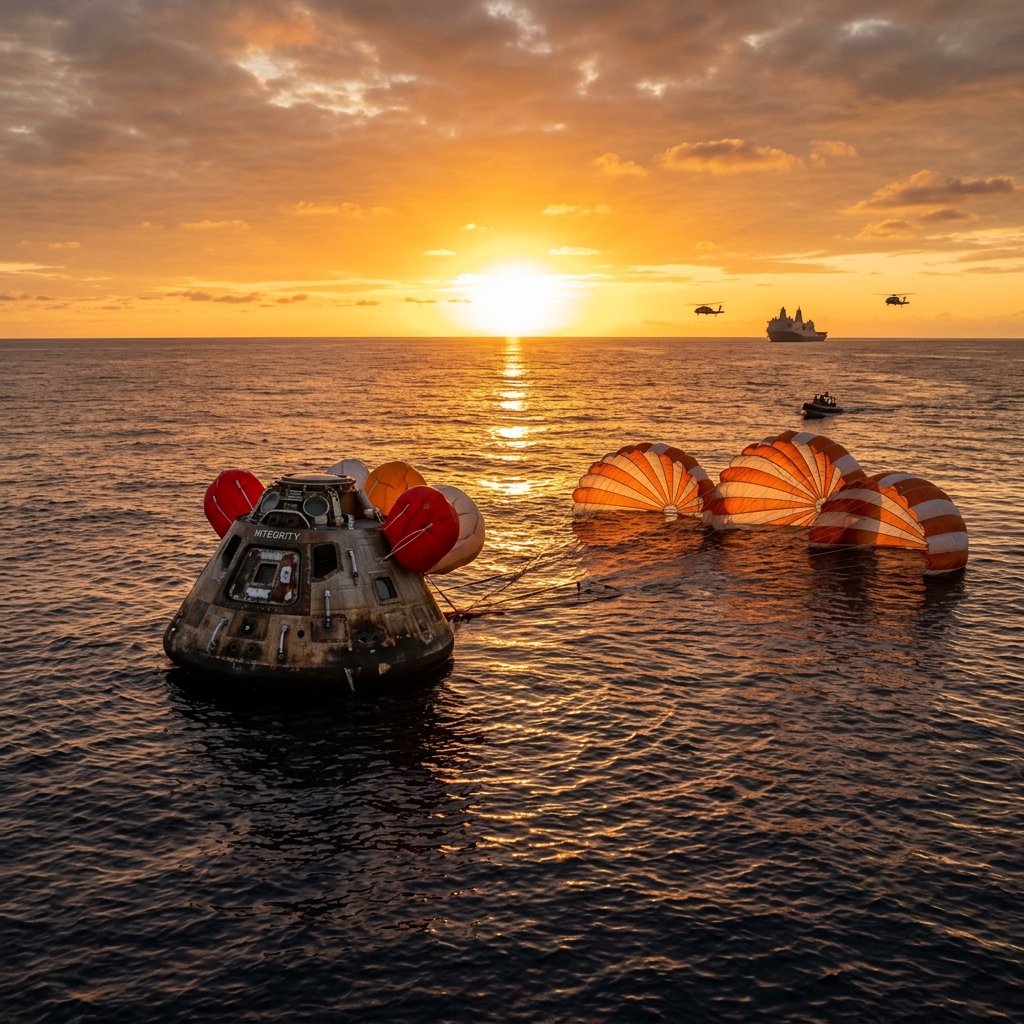
Return day brought one final major demonstration: high-speed atmospheric re-entry and splashdown recovery. Orion hit the upper atmosphere at 400,000 feet, traveling about 35 times the speed of sound, endured the expected communications blackout, then deployed drogue and main parachutes before splashing down successfully off San Diego. Recovery teams from NASA and the U.S. military extracted the crew, flew them by helicopter to the USS John P. Murtha, and began initial post-mission medical checks before the astronauts returned to Houston.
Artemis II’s biggest achievement is that it moved Artemis from promise to proof. The mission demonstrated the crewed performance of SLS, Orion, deep-space navigation and communications, lunar flyby operations, re-entry, and recovery — while also gathering data that will shape future missions to the lunar surface and, eventually, Mars. It underscore that Artemis is not just a NASA program, but a partnership-driven return to deep space.