THE INFRARED EYE
JWST STATUS: ACTIVE OBSERVATION
A New Wavelength
The James Webb Space Telescope (JWST) is the most powerful observatory ever launched. Designed to solve mysteries in our solar system, look beyond to distant worlds around other stars, and probe the mysterious structures and origins of our universe and our place in it.
I. PIERCING THE DUST
Webb's infrared vision allows it to see through the thick clouds of gas and dust that hide objects from optical telescopes. This capability is essential for studying the birth of stars inside stellar nurseries and the formation of planets in protoplanetary disks. It is also the key to observing the first galaxies that formed after the Big Bang, whose light has been "redshifted" into the infrared by the expansion of the universe.
II. THE GOLDEN HONEYCOMB
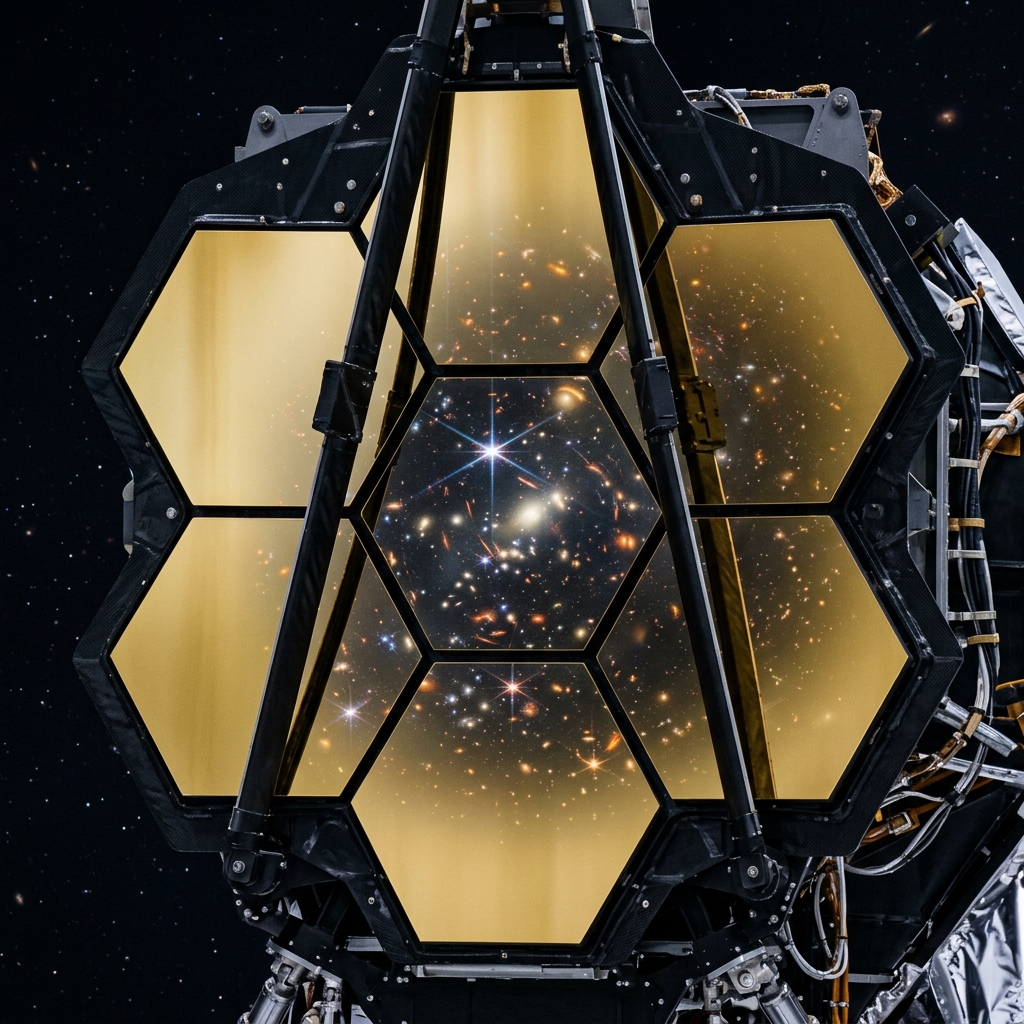
The telescope's primary mirror consists of 18 hexagonal segments made of beryllium and coated with a thin layer of gold. This design creates a massive 6.5-meter collecting area that can capture the faintest photons from the edge of the observable universe. At its orbit at L2, JWST is shielded from the heat of the Sun, Earth, and Moon by a tennis-court-sized sunshield, allowing its instruments to operate at cryogenic temperatures down to -448°F.
III. EXOPLANET ATMOSPHERES
Beyond deep-field science, JWST is a pioneer in exoplanetary research. By using transmission spectroscopy, Webb can identify the chemical signatures of water, methane, and carbon dioxide in the atmospheres of planets orbiting distant stars. This data is fundamental to the search for habitable environments beyond our solar system.